



Date: Dec 20, 2025 Read: 2816
Share:



Recently, PCEVA, a well-known domestic computer hardware evaluation media, conducted a comprehensive evaluation on Union Memory PCIe 5.0 enterprise SSD UH812a. The test results show that the product not only achieves industry-leading performance but also demonstrates outstanding stability and compatibility in enterprise application scenarios such as Oracle databases, VSI virtualization, and VDI desktop cloud. It provides users with storage solutions that feature high performance and high reliability.
PCEVA is a computer information website and technical forum founded in 2010 by senior industry professionals, focusing on providing hardware evaluation, consumption guides, and technical exchange services. The team has over a decade of operating experience, setting up an independent product laboratory and professional editorial team. Taking user requirements at its core, PCEVA adheres to objectivity and practicality, aiming to solve practical problems.
The following content is excerpted from the official release of PCEVA.
Established in 2017, Union Memory is an all-field and scenario solid-state storage solutions provider engaging in enterprise, data center and consumer SSDs, and embedded storage. The device under evaluation today is Union Memory’s new-generation PCIe 5.0 enterprise SSD: UH812a.
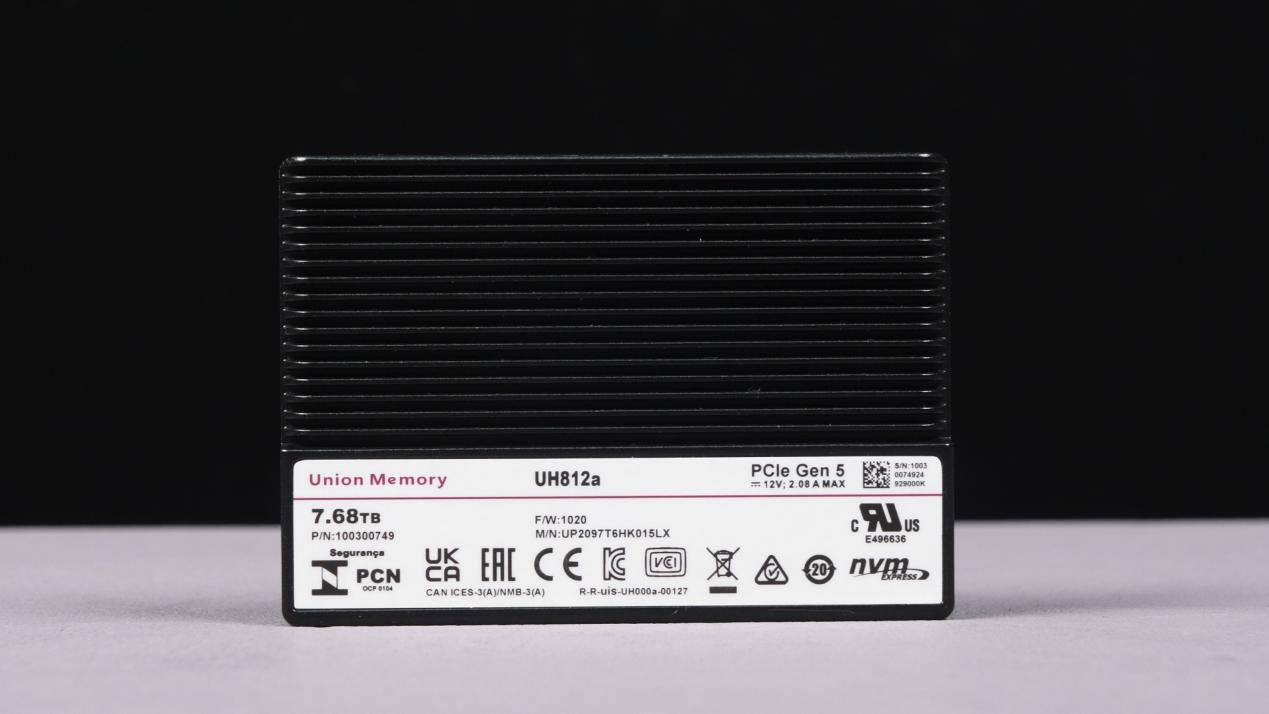
UH812a is built with an enterprise main controller developed by Union Memory, offering sequential read speed of 14,900 MB/s and up to 3,500K IOPS in 4K random read performance. It supports multi-scenario applications, including AI, databases, HPC, cloud, big data, etc.
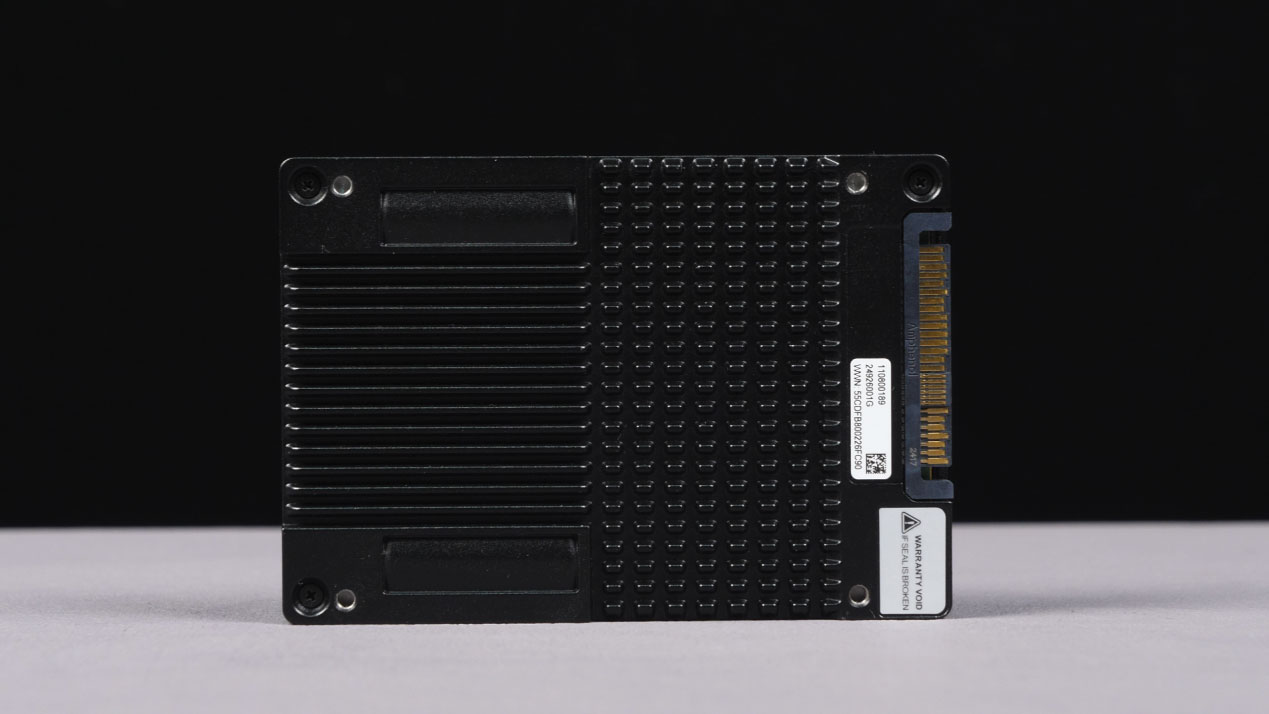
Union Memory UH812a has two forms, namely, U.2 and E3.S 1T. The version tested this time is U.2. After removing the SSD enclosure, an energy storage capacitor can be seen in the lower right of the following picture. This capacitor ensures that the data stored in the DRAM cache can be fully written in the flash memory to supply electric energy in case of an unexpected power failure. In contrast, power failure protection on consumer SSDs is relatively simple. It can usually prevent device bricking but cannot guarantee data integrity.
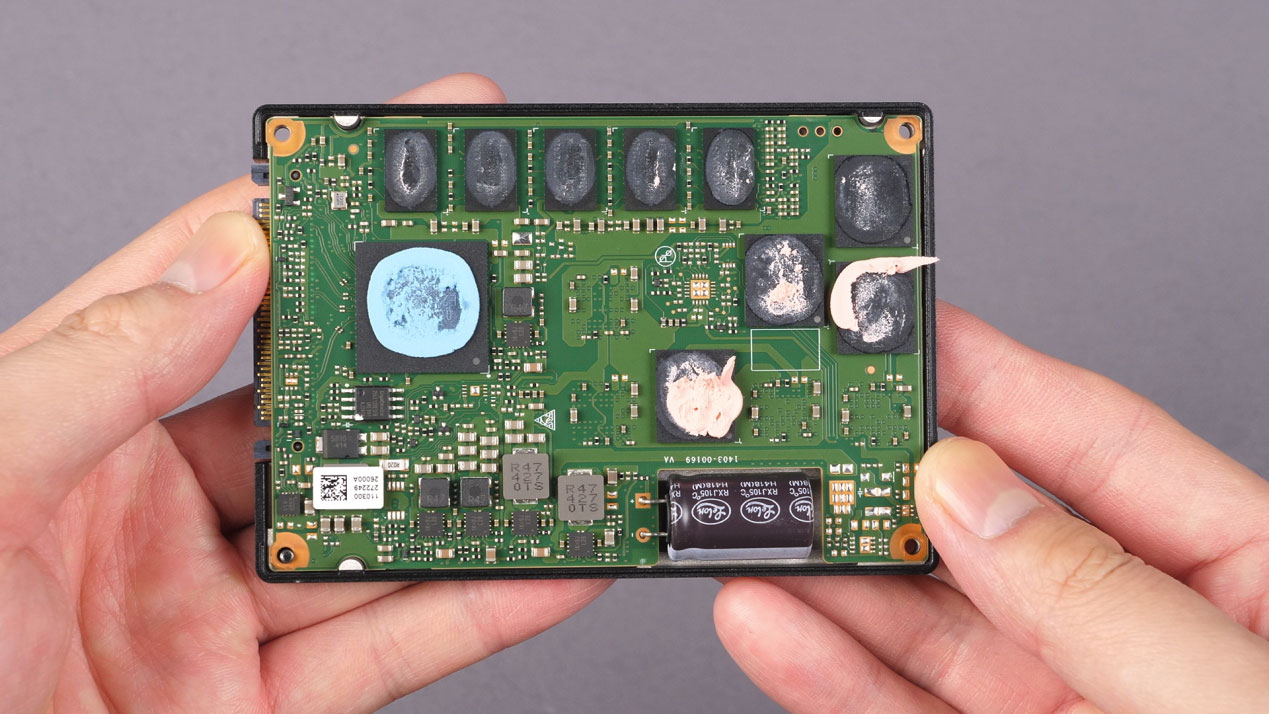
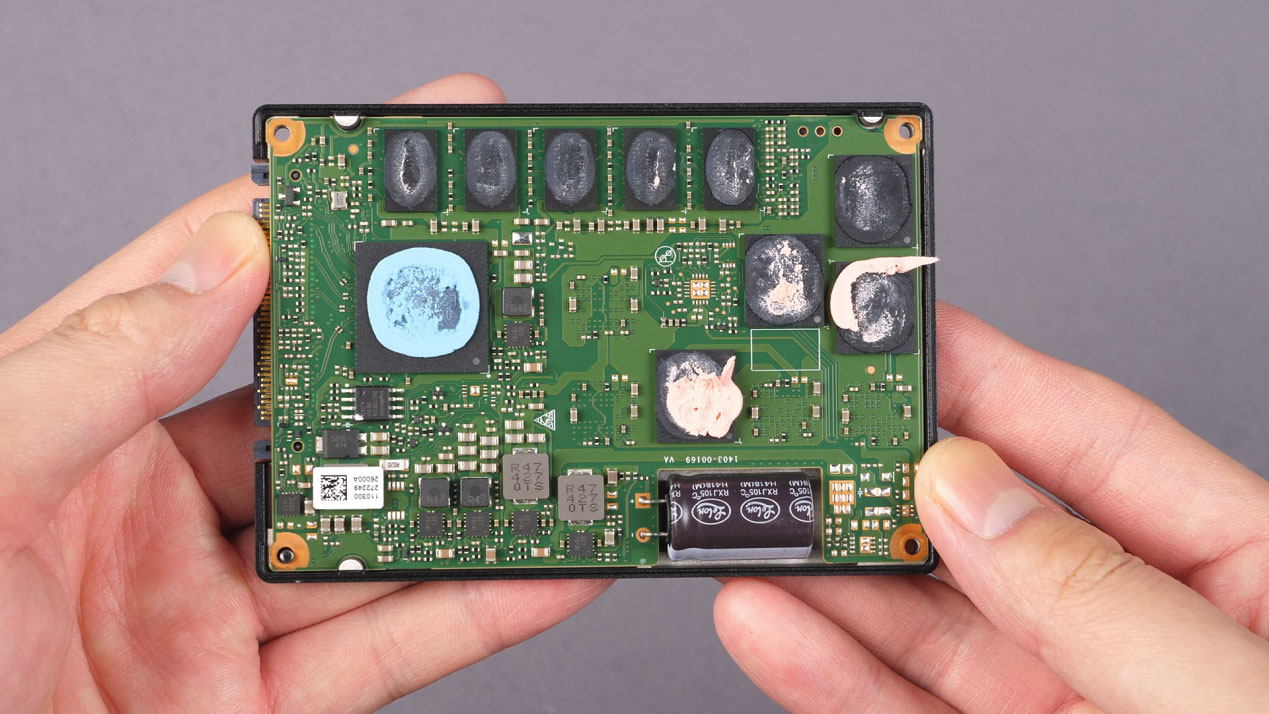
The main controller is manufactured by adopting an industry-leading 7 nm process, which supports multi-level data protection and is compatible with 3D TLC and 3D QLC NAND flash. Compared with the previous-generation PCIe 4.0 Union Memory UH811a series, UH812a doubles the sequential and random read/write performance, achieving a QD1 random read latency of ≤55μs, and making an improvement of 43%.
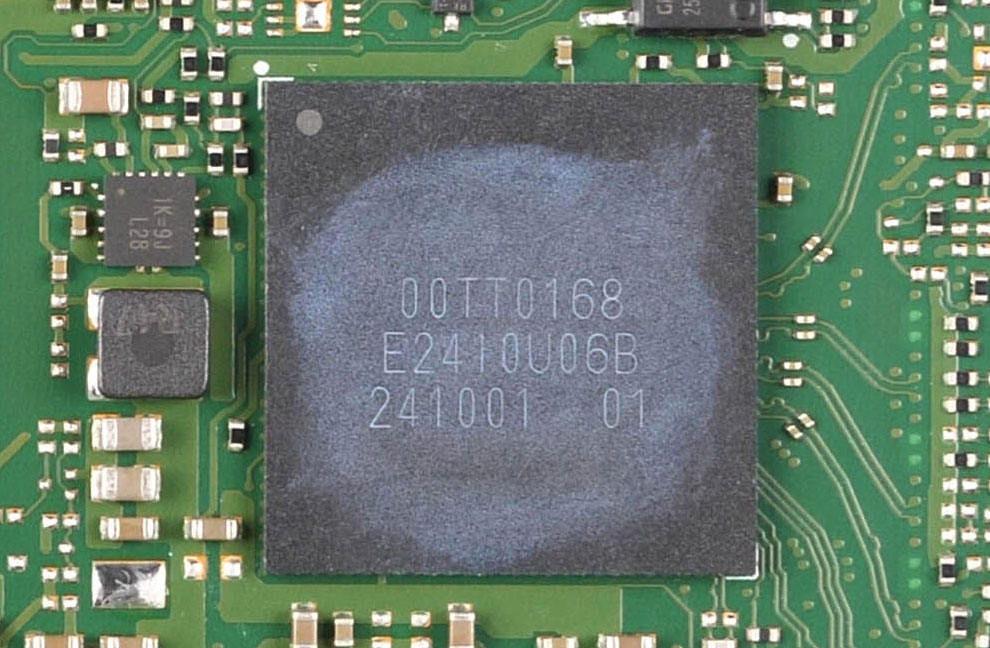
UH812a provides 1DWPD endurance, while the UH832a after increasing the OP reserved space offers 3DWPD endurance. At the firmware level, Union Memory improves flash durability through an enhanced LDPC error correction algorithm. With LDPC + DSP algorithm integration featuring hard decision, soft decision and DSP processing, flash lifespan can be improved by 5 times.
Below are the specification parameters for UH812a/UH832a. The device tested is UH812a 7.68TB.

|
Model |
UH812a |
UH832a |
||||||
|
Capacity |
1.92 TB |
3.84 TB |
7.68 TB |
15.36 TB |
1.6 TB |
3.2 TB |
6.4 TB |
12.8 TB |
|
Sequential read (128KB) |
14,000 MB/s |
14,900 MB/s |
14,900 MB/s |
14,900 MB/s |
14,000 MB/s |
14,900 MB/s |
14,900 MB/s |
14,900 MB/s |
|
Sequential write (128KB) |
3,000 MB/s |
6,000 MB/s |
10,500 MB/s |
9,200 MB/s |
3,000 MB/s |
6,000 MB/s |
10,500 MB/s |
9,200 MB/s |
|
Random read IOPS (4KB) |
2,000K |
3,500K |
3,500K |
3,300K |
2,000K |
3,500K |
3,500K |
3,300K |
|
Random write IOPS (4KB) |
230K |
260K |
470K |
520K |
380K |
560K |
1,000K |
1,000K |
|
Average read/write latency @QD1 |
55/6 μs |
55/6 μs |
55/6 μs |
55/6 μs |
55/6 μs |
55/6 μs |
55/6 μs |
55/6 μs |
|
Total written data |
3.50PB |
7.01PB |
14.02PB |
28.03PB |
8.76PB |
17.52PB |
35.04PB |
70.08PB |
|
Weight U.2/E3.S ±10g |
148/110g |
148/110g |
148/110g |
158/120g |
148/1l0g |
148/110g |
148/110g |
158/120g |
|
Power consumption |
Idle power consumption ≤ 5 W, max. sequential read power consumption ≤ 18 W, peak full-drive power consumption ≤ 24 W |
|||||||
|
Endurance rating (4K random) |
1DWPD |
3DWPD |
||||||
|
Form |
U.2/E3.S 1T |
|||||||
|
Flash medium |
YMTC X3 eTLC |
|||||||
|
Basic functions |
||||||||
|
Sector size |
512/512+8/4096/4096+8/4096+64 sectors |
|||||||
|
Product features |
Power failure protection/pre-read/intelligent multi-stream/NVMe 2.0/atomic write/multi-level power consumption/SRIOV with QoS/MI 1.2b |
|||||||
|
Product upgrade |
Online fast upgrade via NVMe command |
|||||||
|
Reliability |
||||||||
|
Unrecoverable bit error rate |
1E-18 |
|||||||
|
Mean time between failures |
2.5 million hours |
|||||||
|
Annualized failure rate |
0.35% |
|||||||
|
Data retention (power-off) |
Data retention is up to 3 months after endurance life reaches 100% (@40°C). |
|||||||
|
Warranty period |
5 years (within the total written data) |
|||||||
Test platform:
CPU: AMD Ryzen 7 7800X3D
Motherboard: GIGABYTE X670 AORUS ELITE AX
Memory: Kingston DDR5-6000 16G B *2
SSD: Plextor M6Pro 128GB (system disk)
Union Memory UH812a 7.68TB
OS: Ubuntu 24.04 LTS
Smartmontools can be used to review the basic information of SSD. UH812a offers 7.68TB as a user-available capacity, supporting 2 firmware slots and online firmware upgrades. It is compatible with 512/512+8/4096/4096+8/4096+64 sector formats. UH812a integrates multiple power modes with dynamic adjustment, enabling the controller to automatically match frequency and internal resources according to different operation loads. Through refined power management, it reduces energy consumption, and achieves disk-level green energy savings.
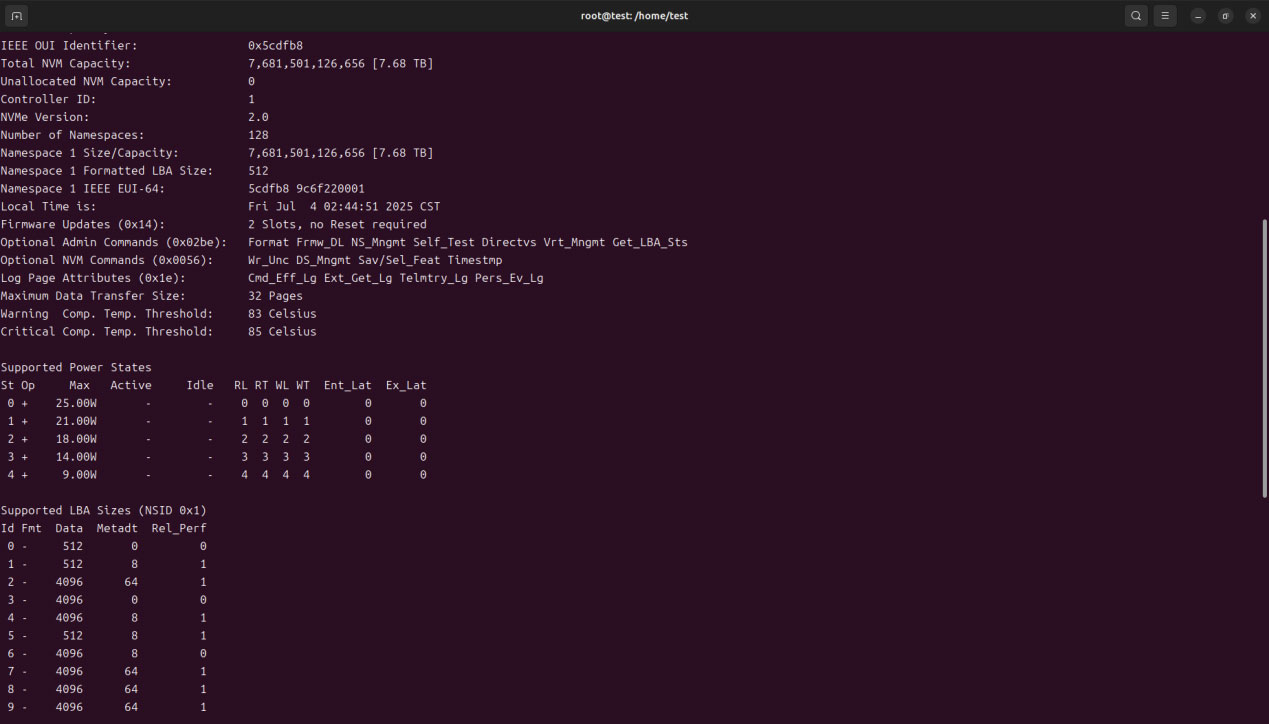
UH812a supports up to 128 namespaces, allowing a single physical SSD to be split into multiple independent virtual storage units. Each namespace can be configured with different sector formats and allocated to specific applications. IOPS and bandwidth QoS thresholds can also be set as per namespace to realize fine traffic control.
1. gfio test: Sequential read/write 14.9/10.6 GB/s, 4K read/write latency 55/6 μs
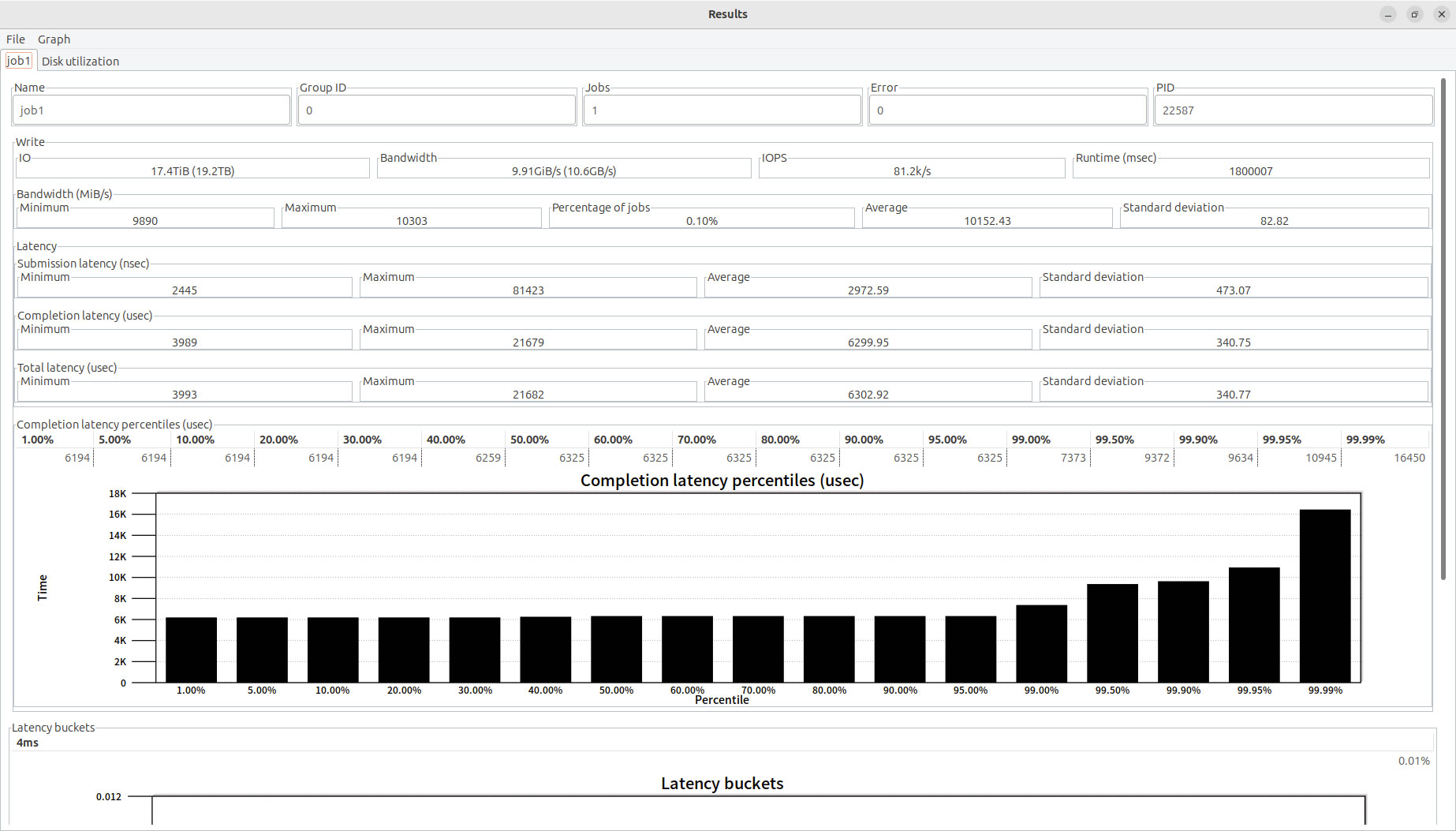
Fio is a powerful storage performance test tool, and gfio offers a graphical interface for easy operation. Users still need to prepare configuration files manually and load them via gfio. During the test, gfio refreshes and displays the transmission bandwidth and IOPS values every second. Test is started with pre-processed drive writing, performing two rounds of sequential drive writing with 128KB QD512.
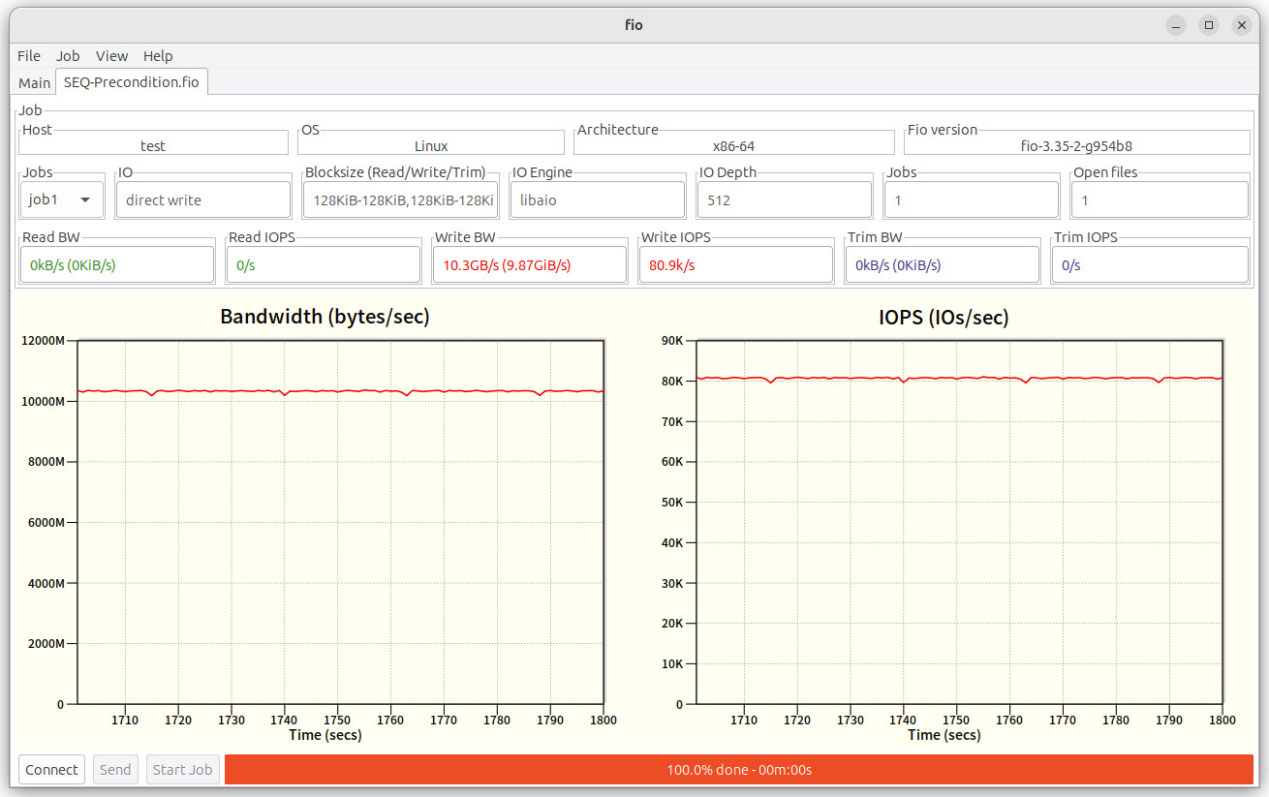
Union Memory UH812a 7.68 TB achieves an average write speed of 10.6 GB/s, which is 1.77 times faster than similar products of leading international competitors.
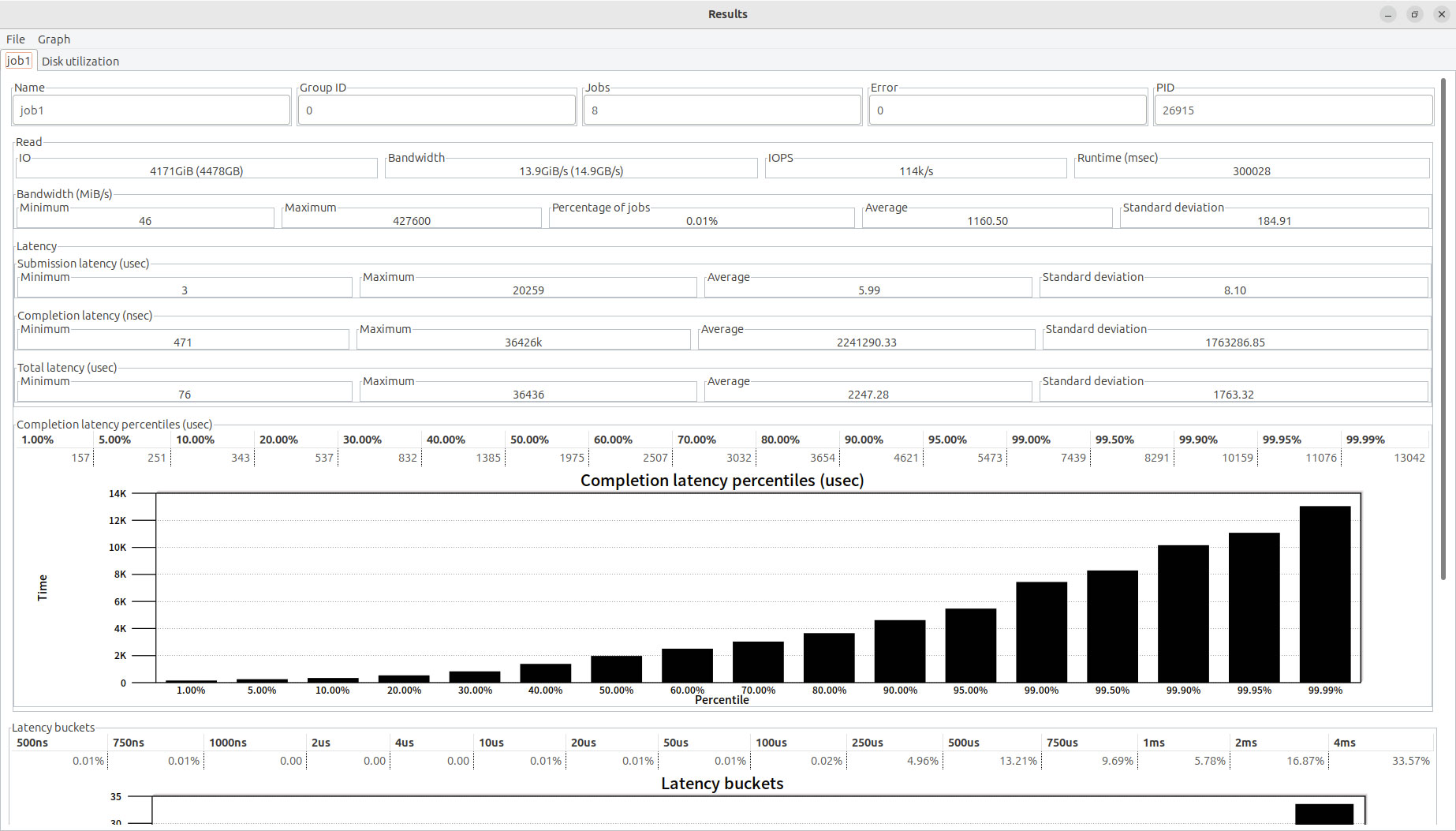
Next, sequential read performance is tested. The average bandwidth reaches 14.9 GB/s, outperforming 14 GB/s from the similar products of leading international competitors.
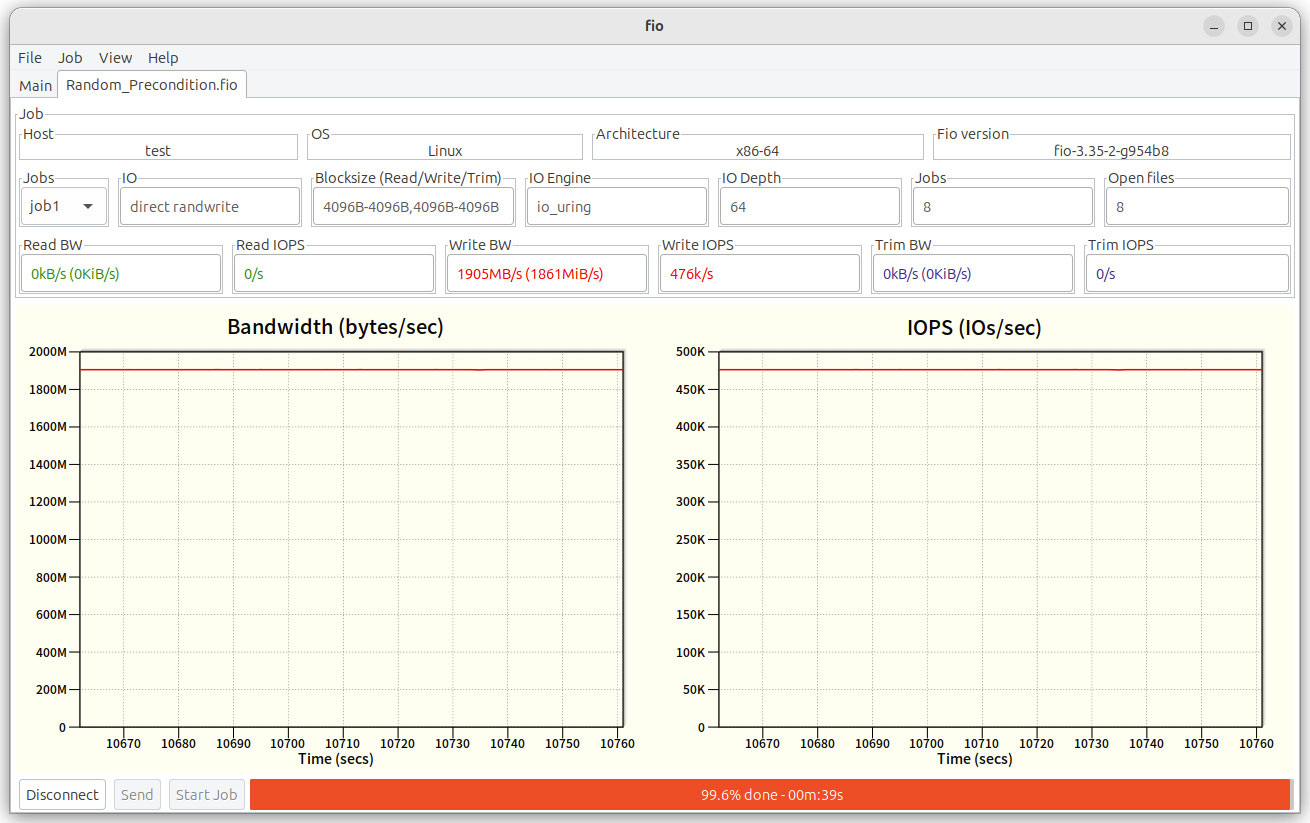
For the random write performance test, an nvme format is performed first, followed by a full-drive sequential write with 128KB QD512, and then a sustained 4K Q64T8 random write for 3 hours. Under steady state conditions, Union Memory UH812a 7.68 TB achieves 476K IOPS in 4K random write, surpassing the rated 470K IOPS specification.
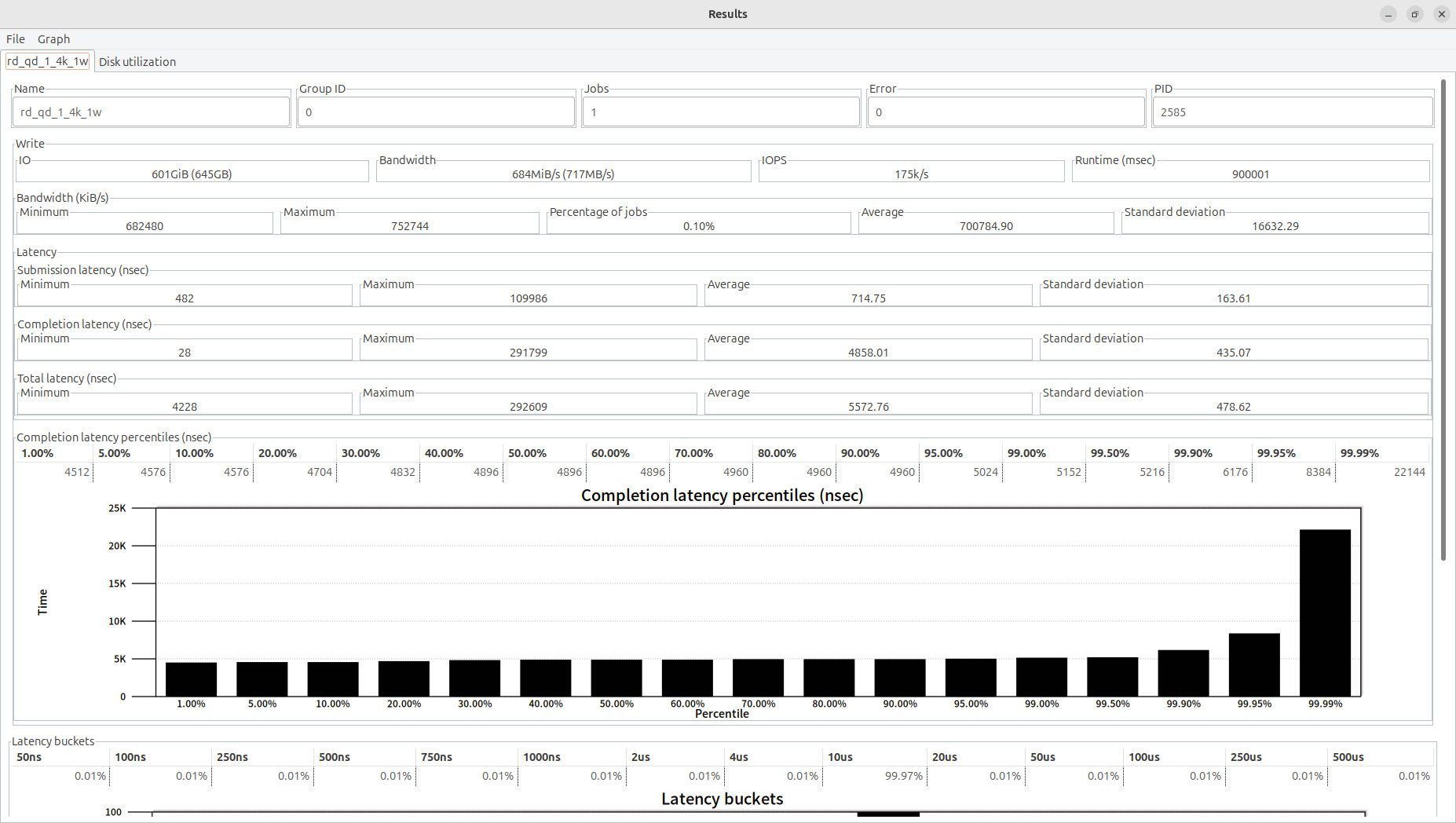
The read/write latency test is conducted by using 4K QD1 random read/write. The average 4K random write latency of Union Memory UH812a 7.68 TB is below 6 μs:
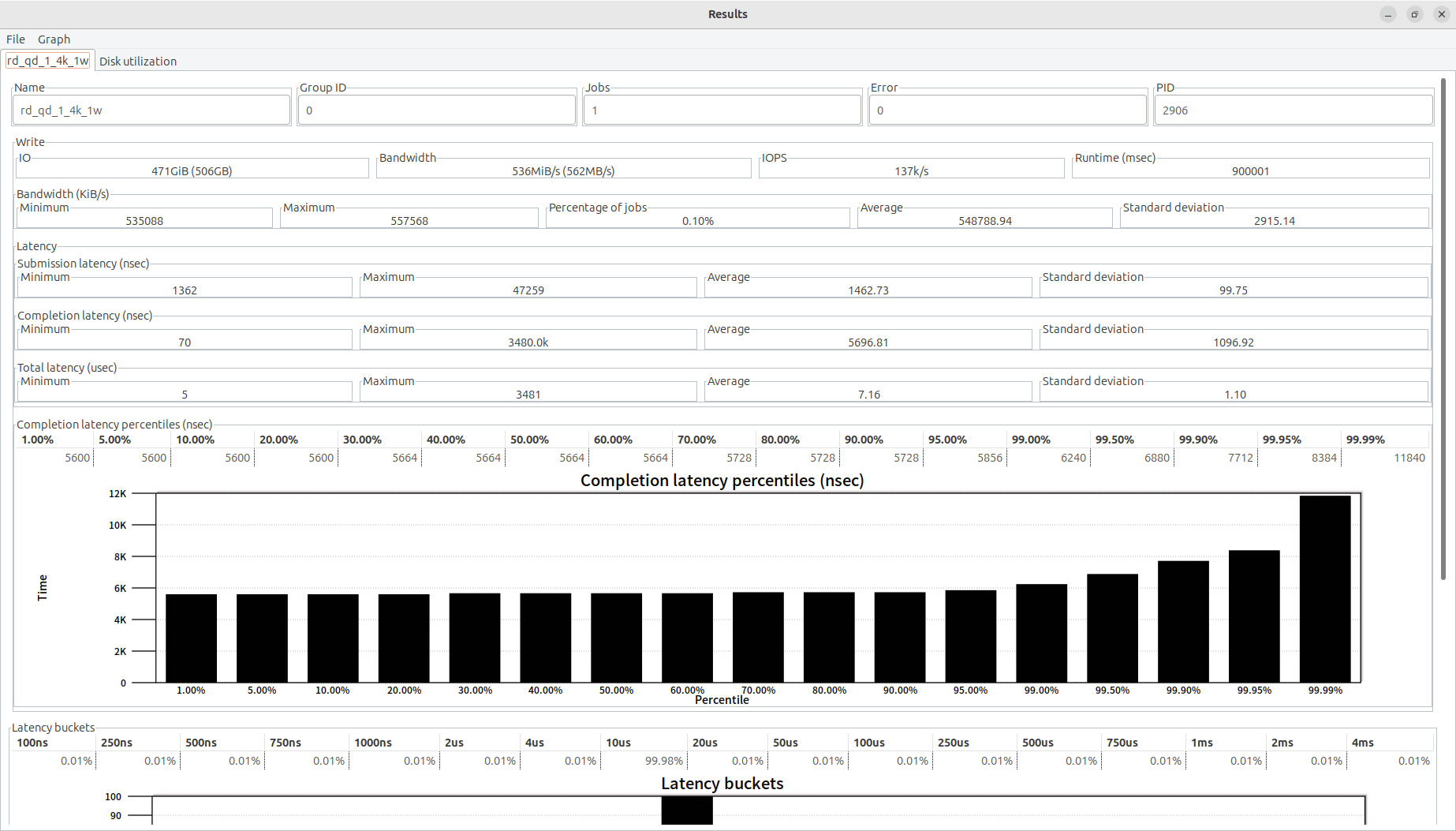
The average 4K random read latency is 55 μs:
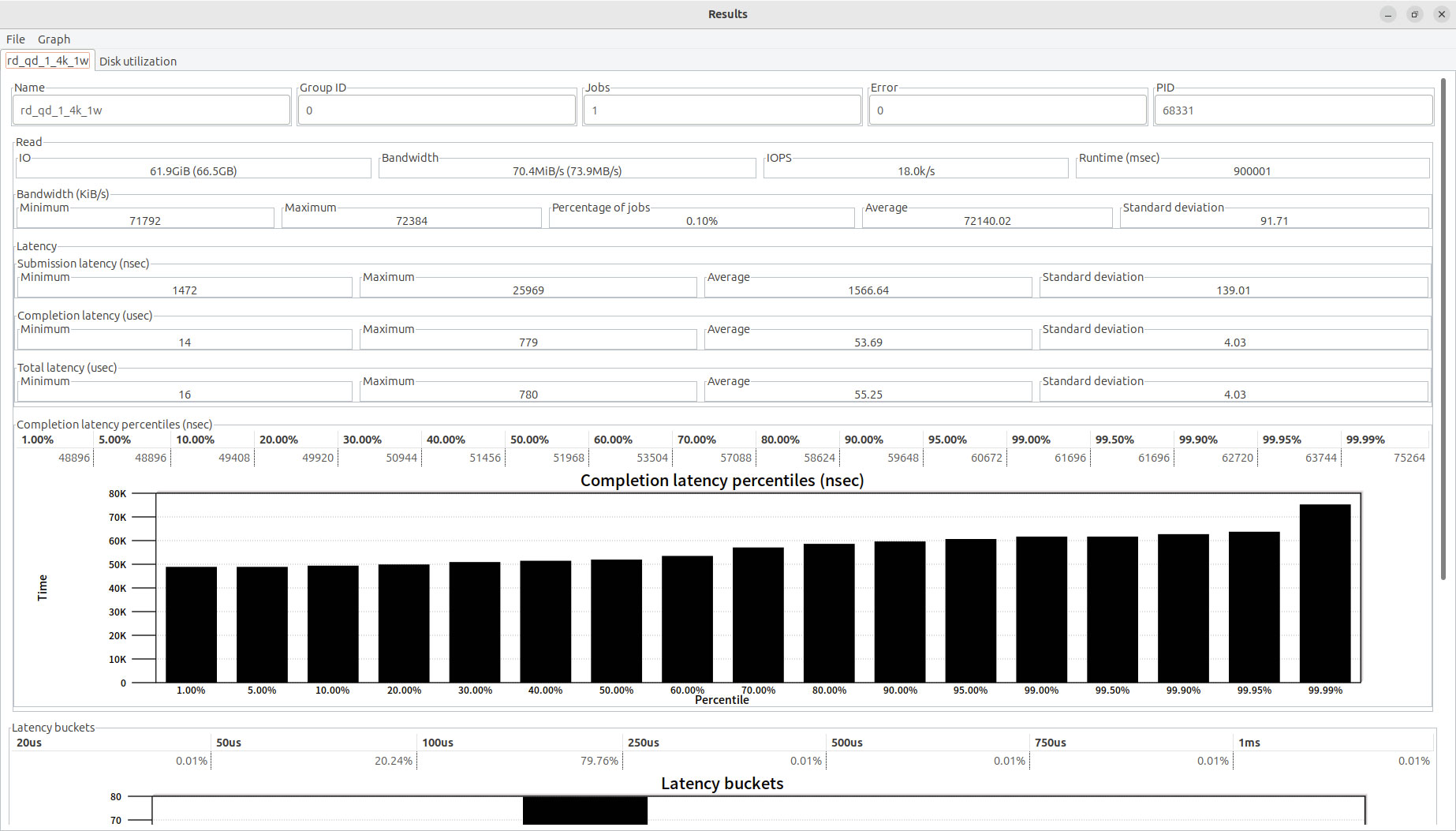
2. ezfio test: 4K random read 3,569K IOPS, mixed read/write 1,182K IOPS
The previous gfio tests have verified Union Memory UH812a sequential throughput, steady state 4K random write, and average latency. In practical applications, enterprise SSDs will face more complex challenges such as mixed read/write and stringent latency percentile requirements. The ezfio automated testing scripts can be used for this type of evaluation.

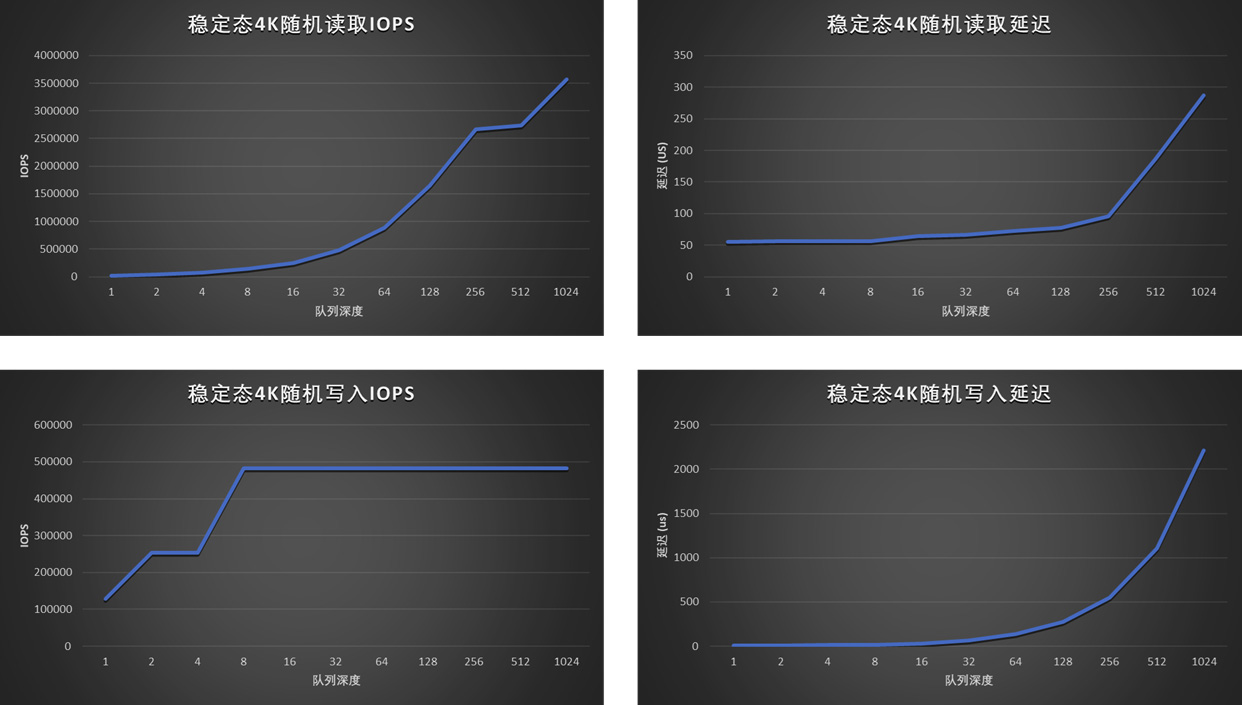
To meet the testing requirements of Union Memory UH812a, the ezfio scripts are modified to increase the maximum queue depth and fully showcase the performance potential of UH812a. In steady state test, UH812a 7.68 TB delivers 3,569K IOPS in 4K random read and 470K IOPS in 4K random write IOPS. Under QD=1, 4K random read/write latency remains excellent at 55μs/6μs, respectively.
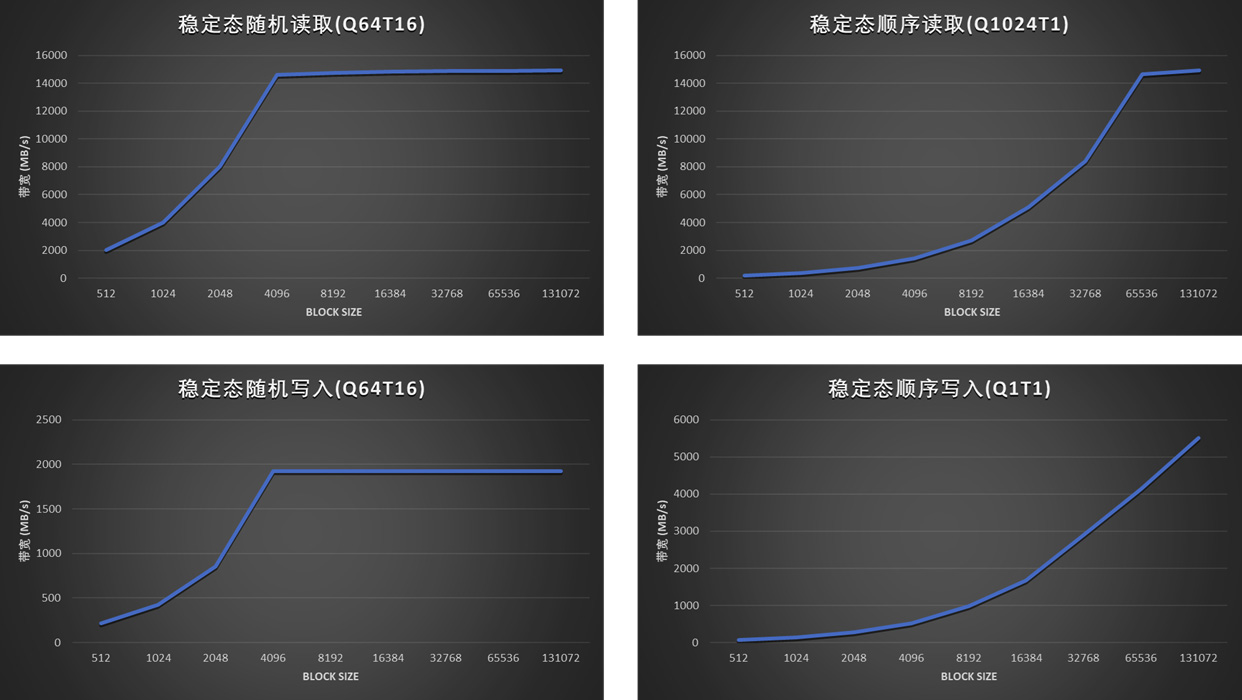
Steady state sequential and random read/write tests are further conducted under different block sizes. Sequential read performance peaks at 14,931 MB/s, achieving full-speed read in the PCIe 5.0 ◊ 4 interface.
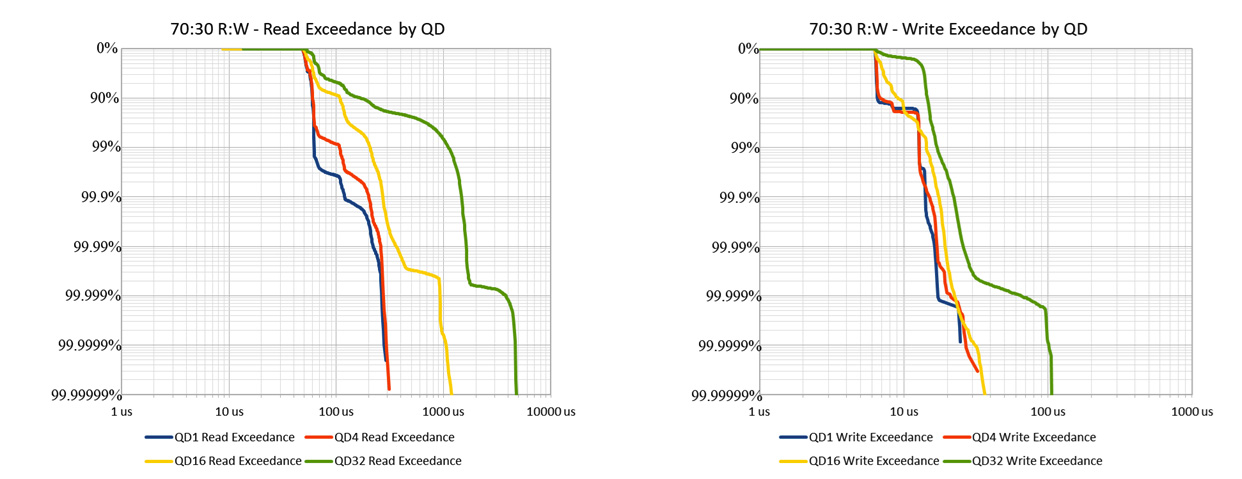
Mixed read/write imposes greater stress on SSDs than pure read/write and better reflects the actual use performance of SSDs. Using 4K QD1024 mixed random read/write (with a 70:30 read/write ratio), Union Memory UH812a 7.68 TB maintains exceptional stability with average steady state 4K mixed random read/write IOPS reaching 1182438, standard deviation 1687, and coefficient of variation 0.14%.

Steady state percentile latency performance for 4K mixed random read/write of Union Memory UH812a 7.68TB:
3. SNIA SSS PTS-E 2.0 test: Performance above rated specification
Solid State Storage Performance Test Specification (SSS PTS) is a storage performance test standard developed by Storage Networking Industry Association (SNIA). The current version is SSS PTS 2.0, consisting of PTS-E for enterprise SSDs and PTS-C for consumer SSDs.

Usually, NAND-based SSDs exhibit higher performance during the fresh-out-of-the-box (FOB) stage and immediately after formatting. As the NAND contains no valid user data, it does not require garbage collection during writing, resulting in the relatively high performance of SSD. As the SSD continues to be used, the NAND gradually fills up with valid and invalid data. When new write operations occur, GC must be performed first, causing write performance of SSD to decline until it eventually reaches a steady state.
PTS focuses on testing the steady state performance of SSDs. To ensure comparability in different SSDs, test must be conducted without interference from a file system. In other words, SSD should be tested without partitions such as FAT, NTFS, or EXT being created.
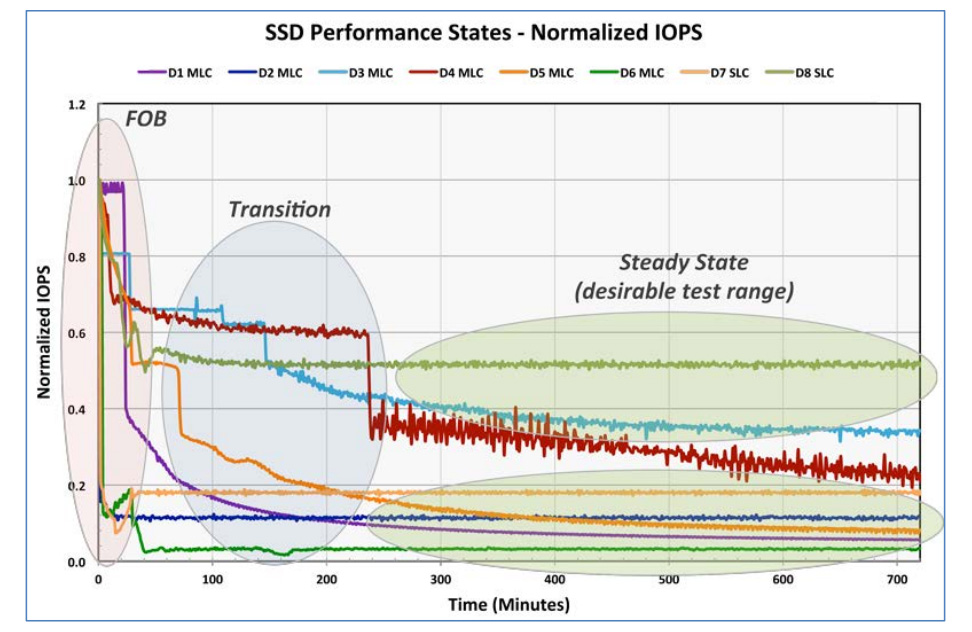
To make the SSD reach a steady state, PTS test requires a preprocessing step, which is commonly referred to as “drive writing”. It then performs up to 25 rounds of random mixed read and write operations. These operations use block sizes of 512 bytes, 4K, 8K, 16K, 32K, 64K, 128K and 1024K. Each block size is tested under seven read and write ratios: 0/100, 5/95, 35/65, 50/50, 65/35, 95/5 and 100/0. This results in a total of 56 test items, with each item running for 1 minute. Each round takes 56 minutes to complete.
The method for determining steady state is as follows: Check the results within the test window for 4K random write, 64K R65:W35 mixed random read/write, and 1024K random read. A fluctuation range of ±10% is allowed. If all five consecutive rounds meet this requirement, the SSD is considered to have reached a steady state.
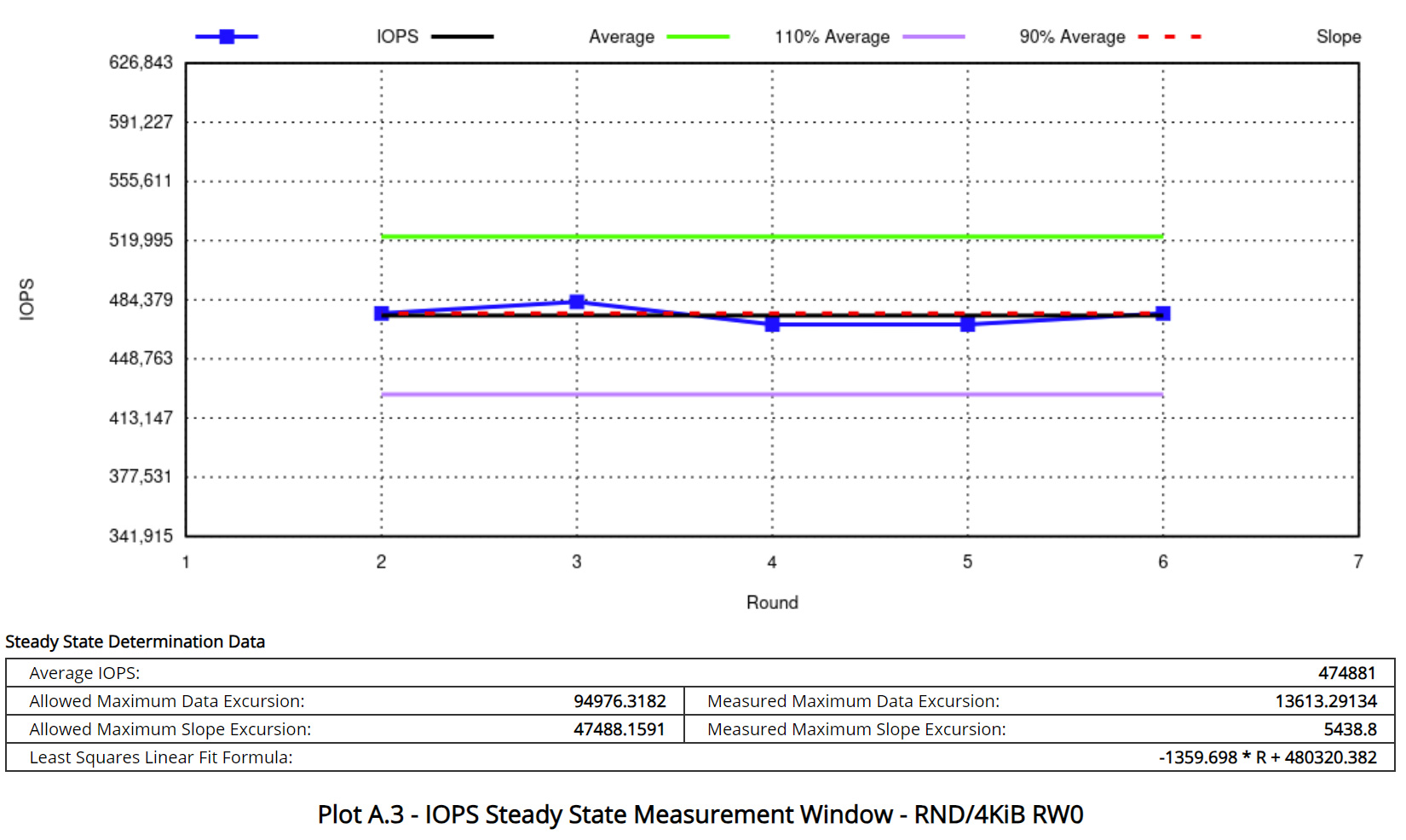
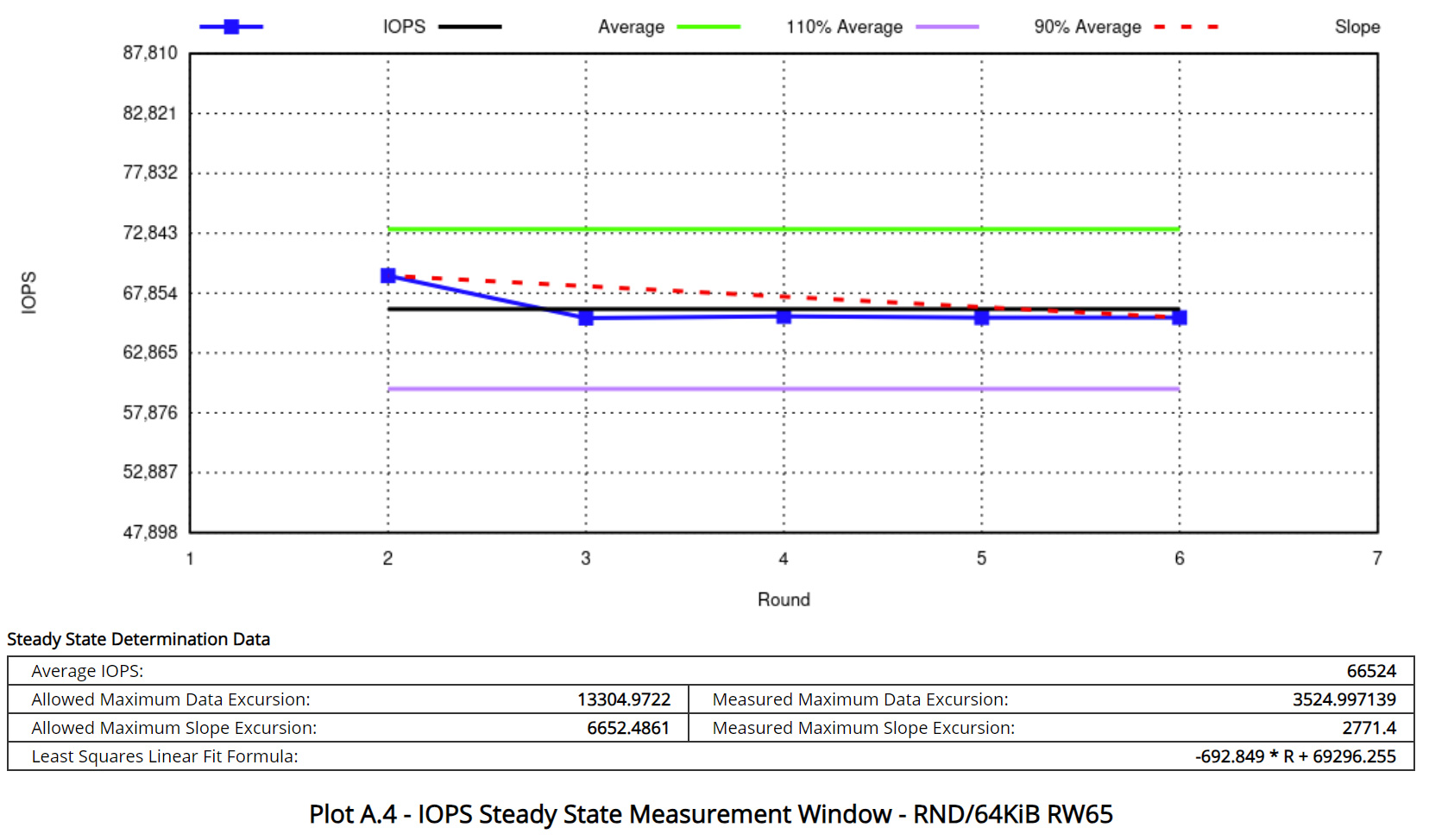
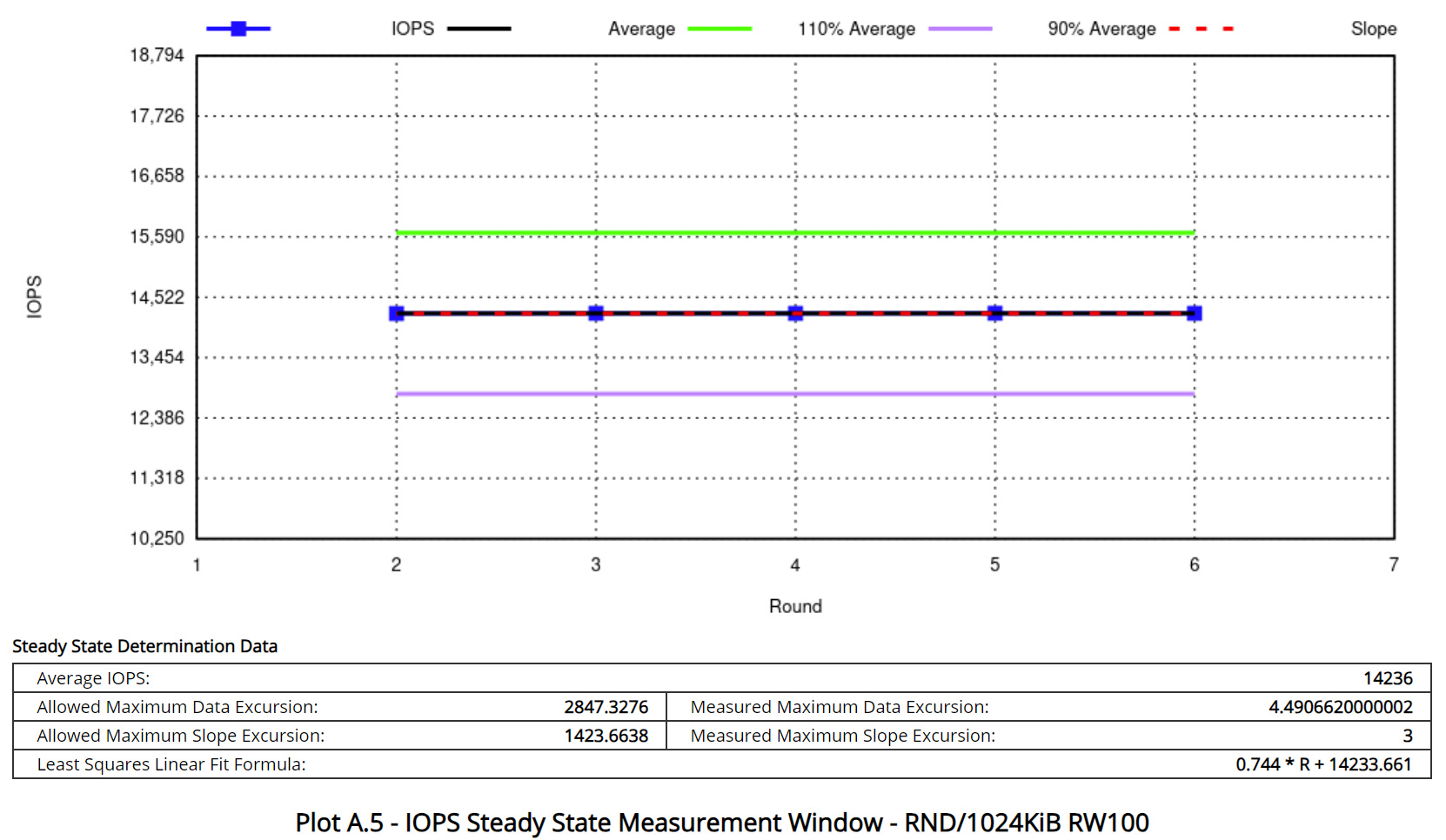
The SSS PTS test requires extracting performance data from 56 steady state test items, which can then be presented in table format, 2D charts, or 3D visualization as needed. To fully unleash the performance potential of Union Memory UH812a, this evaluation is conducted with 16 workloads, with each configured with QD=256. The results are shown in the following table:
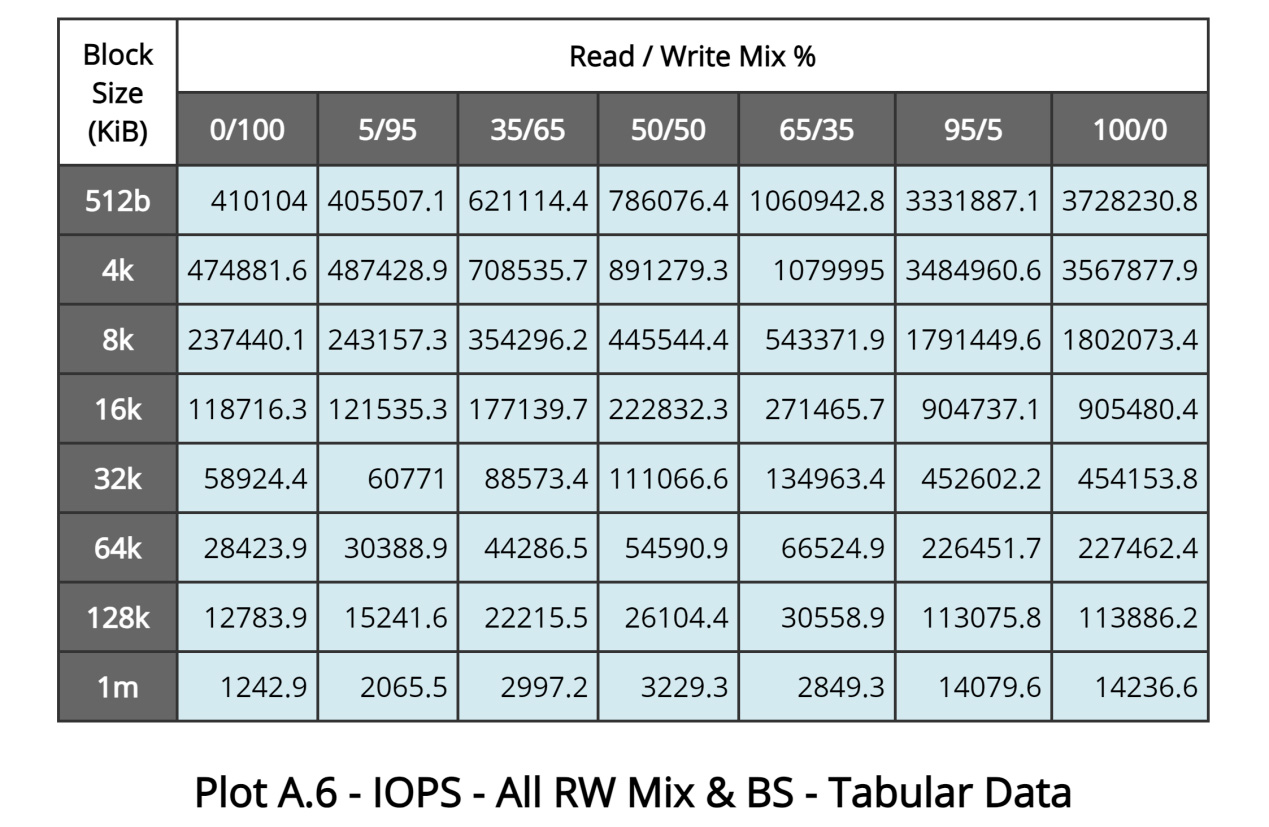
The measured 4K random read reaches 3568K IOPS, and the 4K random write reaches 475K IOPS. Both of them meet and exceed the specified values.
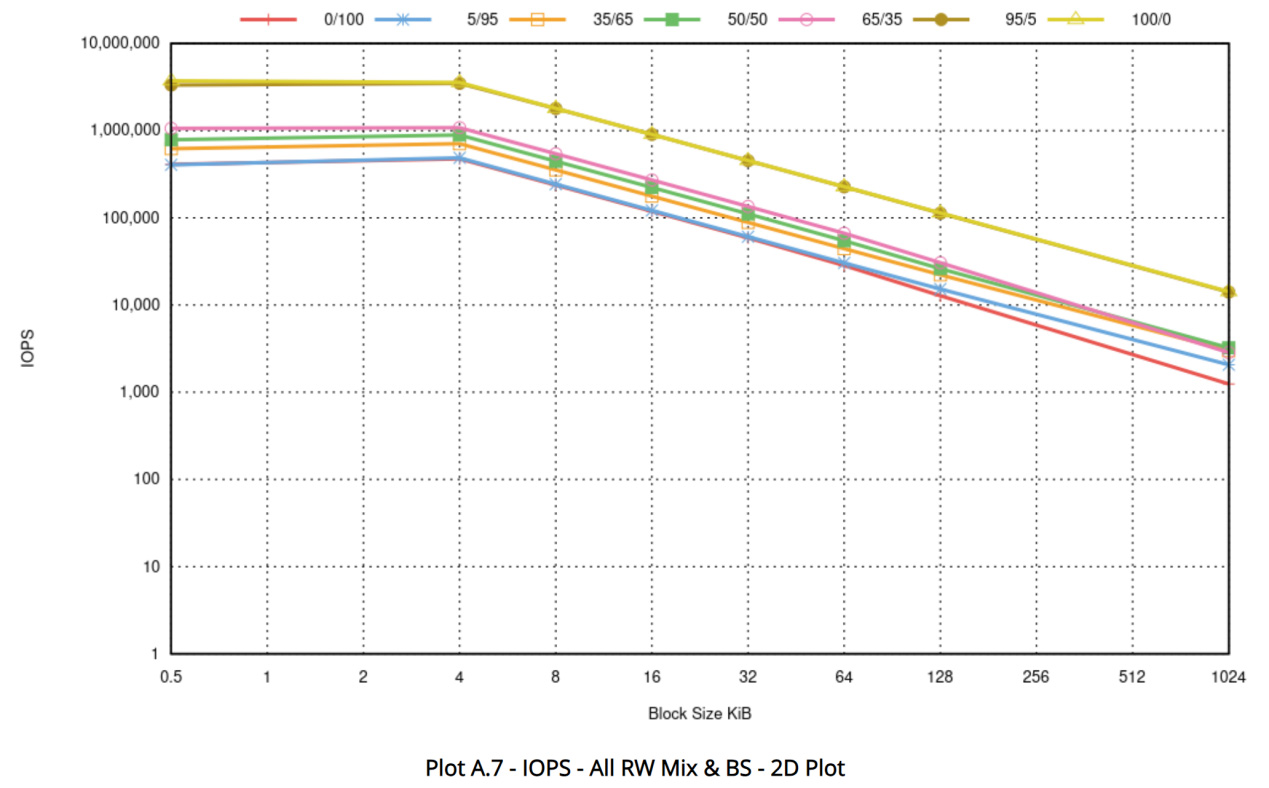

VDBench test:
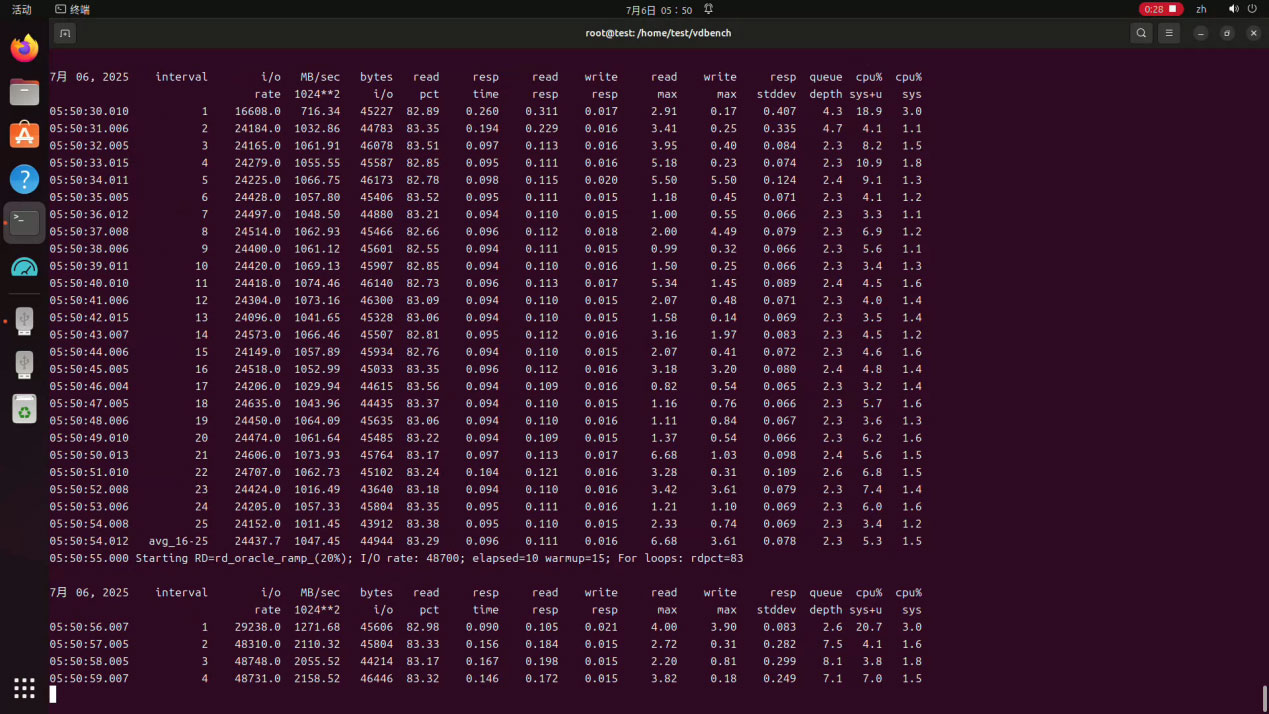
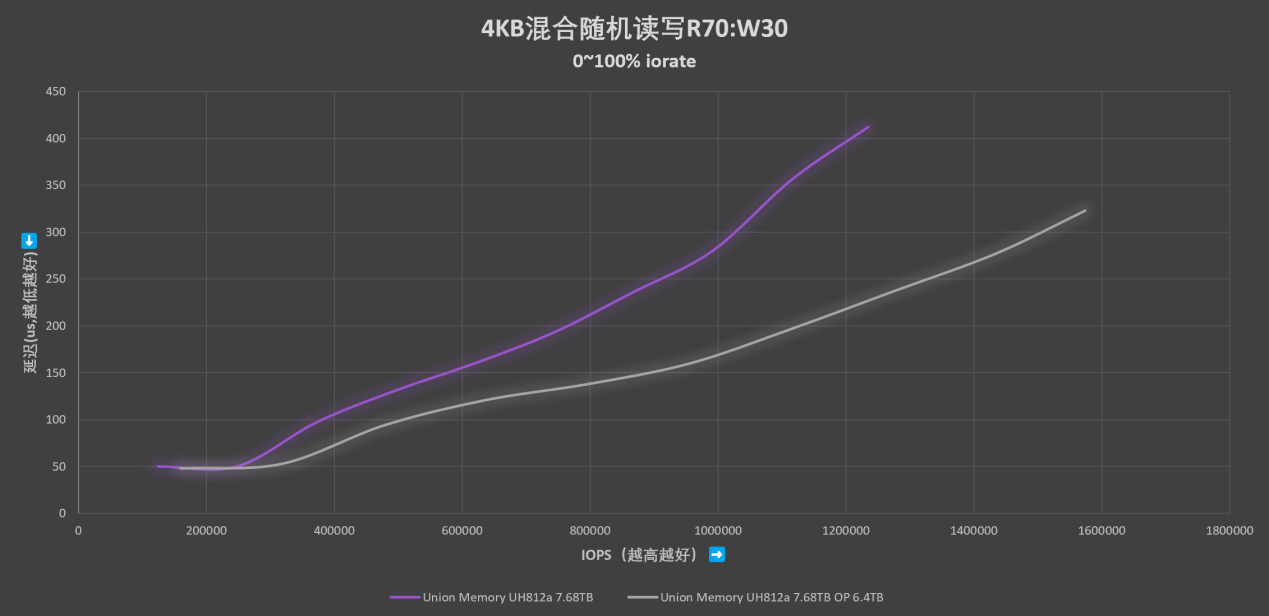
VDBench is a storage performance evaluation tool developed by Oracle, supporting deduplication and compression workloads. Here, we use it to test 4KB mixed random read/write (70% read/30% write) performance and simulate Oracle Database, VDI, and VSI enterprise scenarios.
In the 4KB mixed random read/write test, Union Memory UH812a 7.68TB achieves 1235K IOPS. When over-provisioned (OP) to 6.4TB, the performance is further improved to 1574K IOPS, making it well-suited for demanding enterprise workloads.
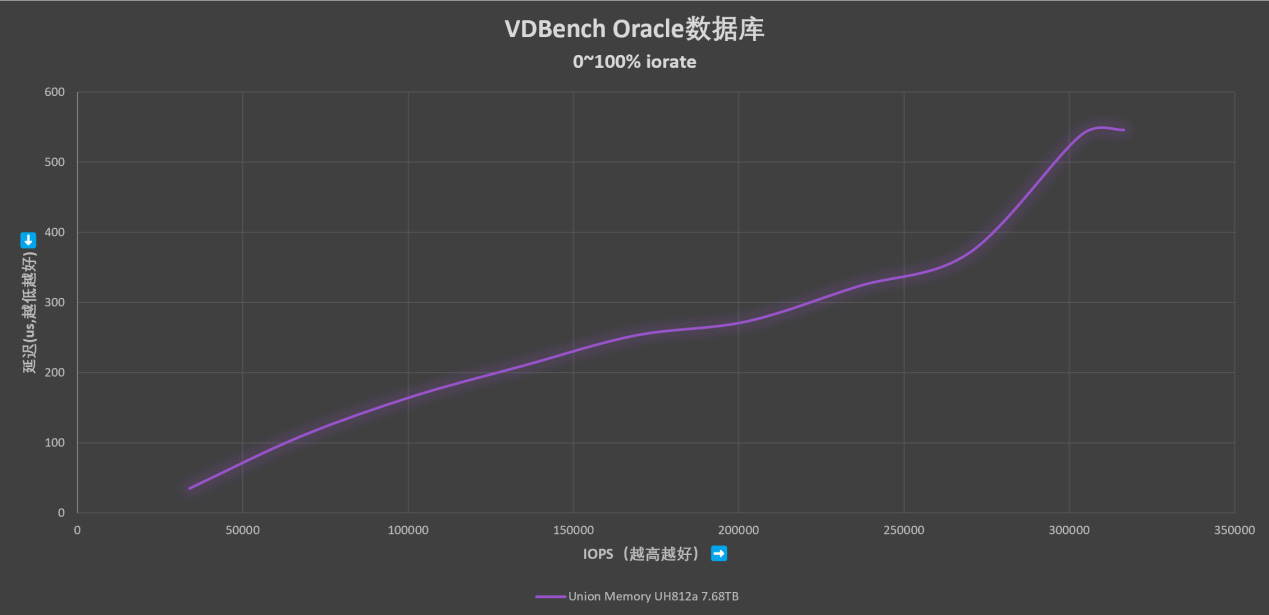
The test models for Oracle, VDI, and VSI, which simulate enterprise applications, are relatively complex and place high demands on SSD performance. In the Oracle test model, the read/write ratios are 83.14% and 16.86%, respectively. In read and write operations, different block sizes correspond to varying proportions. With Dedupratio=3 and Compratio=3, Union Memory UH812a 7.68TB achieves 316K IOPS in the Oracle test stage, demonstrating outstanding performance.
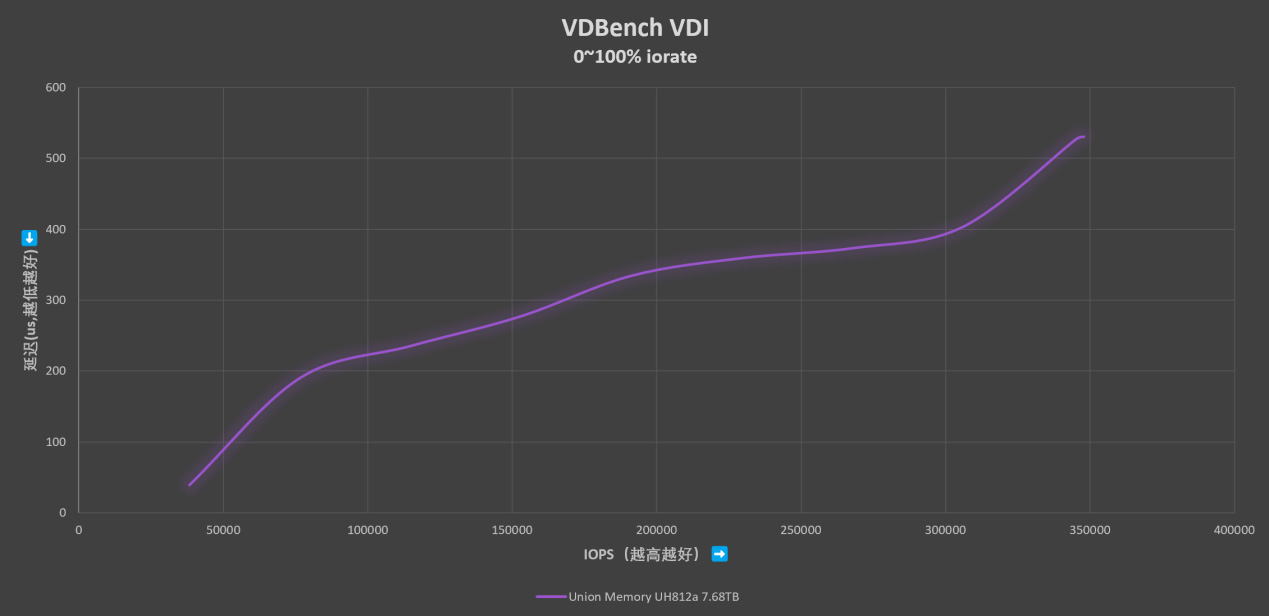
In the Virtual Desktop Infrastructure (VDI) test model, the read/write mix is 59.48:40.52. 4K, 16K, 32K, and 64K read proportions are 39.35%, 16.47%, 10.37%, and 12.86%, respectively, with 80% random access. 4K and 8K writes account for 61.11% and 13.05%, with 80% random access. With Dedupratio=7 and Compratio=8, Union Memory UH812a 7.68TB reaches a peak of 348K IOPS, delivering satisfactory performance.
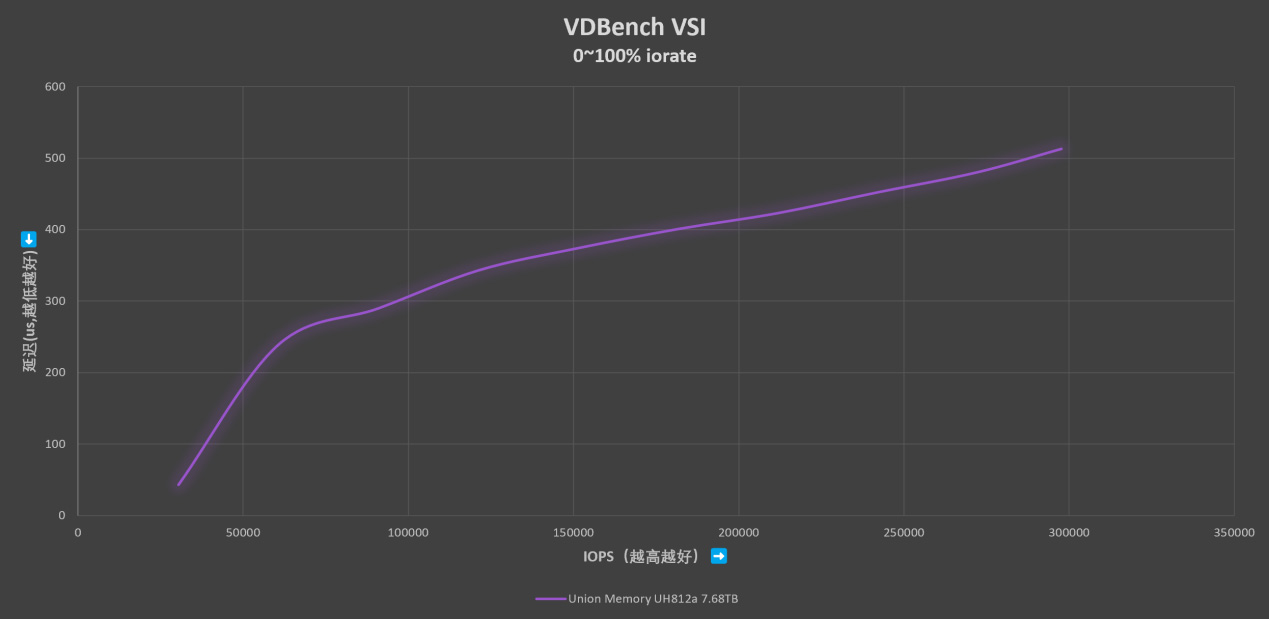
In the Virtual Storage Infrastructure (VSI) test model, the read/write mix is 57.4:42.6. 4K, 8K, and 60K reads account for 25.68%, 26.31%, and 10.52%, with 80% random access. 4K and 8K random writes account for 59.62% and 14.81%, with 80% random access. In this test, Union Memory UH812a 7.68TB achieves a peak of 298K IOPS, meeting the storage performance requirements of diverse workloads and applications.
Summary
These tests fully demonstrate the exceptional performance of Union Memory UH812a: sequential read speed of 14931 MB/s, 4K random read performance of 3569K IOPS, and steady state 4K random write performance of 475K IOPS. At a QD queue depth of 1, UH812a shows average read/write latency of only 55/6μs. Even under complex and variable mixed workload conditions, UH812a delivers outstanding results.
As a solid-state drive partner for Intel Xeon Platform, Union Memory has actively participated in Intel Data Center and AI Division (DCAI) Key Component Validation Plan in China. To date, UH812a has fully passed rigorous Intel BKC certification standards, PCIe link stability tests as well as SPDK, VROC, and OPEA certifications, demonstrating its excellent compatibility and reliability.
It is worth mentioning that UH812a has passed the CSNS neutron irradiation test. According to the information from the official website of Union Memory, neutrons exist widely in cosmic rays, high-altitude environments, and areas surrounding nuclear power facilities. When neutrons penetrate SSD storage units, they may cause unintended bit flipping, resulting in data errors. UH812a, which has passed the neutron irradiation test, provides users with strong assurance of durability and reliability, offering a dual safeguard for safety and efficiency.

None.
Union Memory Debuts at China Mobile Cloud AI Conference 2025, Co-Creating the Shared Future of Intelligent Computing with Industry Partners
Address: 19th Floor, Block B, Ramaxel Houhai Center, Nanshan District, Shenzhen
Tel: +86 755-2681 3300
E-mail: support@unionmem.com
